C++ by Version — What Changed from C++98 to C++26
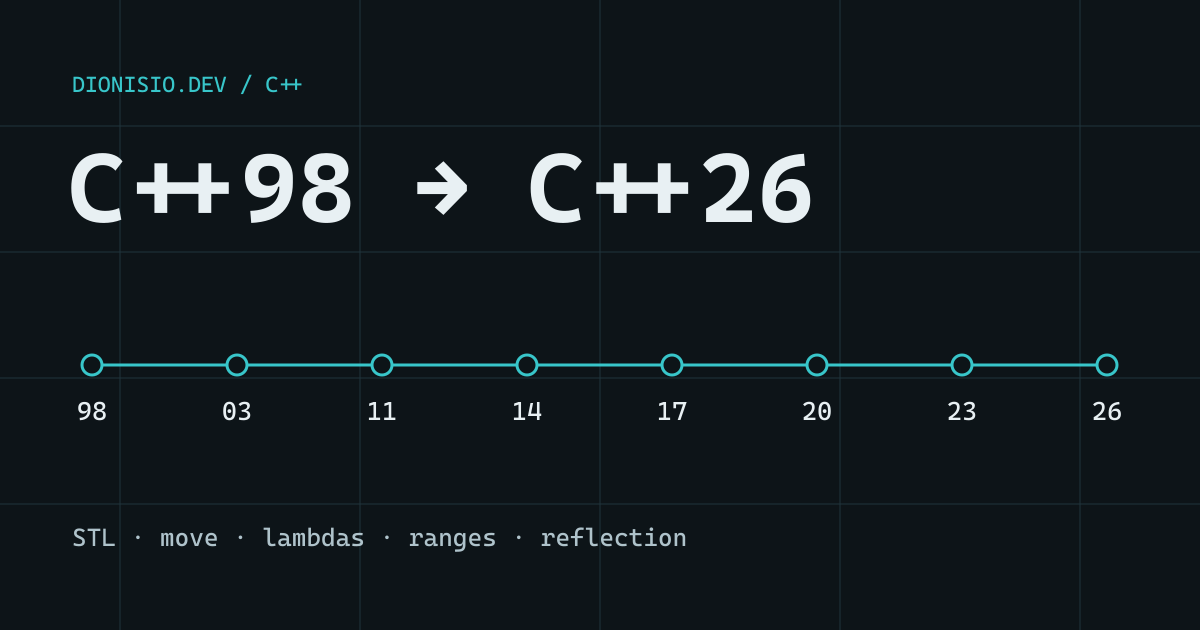
C++ · Language · Standard Library
Your project uses C++. But which C++?
Between managing resources by hand and composing operations with ranges lies a history of engineering decisions. Understanding that history helps you write better code today.
You open one project and find new, delete, raw pointers, and classes whose only job is to pass a function to an algorithm. You open another and see unique_ptr, lambdas, concepts, and ranges. Both are C++. Maintaining them can be a very different experience.
Knowing when a feature arrived helps you avoid reinventing something the library already provides — and shipping code your team’s toolchain cannot compile.
This is a map of the major changes in each edition, with examples and practical consequences. It is not an inventory of every defect report. The reference date is September 15, 2026. There is also a Portuguese edition.
The Quick Map
Section titled “The Quick Map”| Version | Language highlights | Library highlights |
|---|---|---|
| C++98 | First ISO standardization of classes, templates, exceptions, namespaces | STL, strings, streams |
| C++03 | Corrections and value-initialization | Specification and interoperability fixes |
| C++11 | auto, lambdas, move semantics, constexpr, variadic templates | Smart pointers, threads, atomics, chrono, unordered containers |
| C++14 | Generic lambdas, init-capture, more flexible constexpr | make_unique, shared_timed_mutex, integer sequences |
| C++17 | Structured bindings, if constexpr, fold expressions, CTAD | optional, variant, any, string_view, filesystem |
| C++20 | Concepts, modules, coroutines, <=>, consteval | Ranges, span, format, jthread, synchronization |
| C++23 | Deducing this, if consteval, multidimensional subscripting | expected, print, mdspan, generator, more ranges |
| C++26 | Reflection, contracts, pack indexing, expansion statements | Senders/receivers, SIMD, inplace_vector |
Read this as a selection of milestones, not a support guarantee. The language edition, compiler implementation, and library implementation are three different things. The official GCC and Clang tables track those details.
C++98 — The Foundation Still in Your Code
Section titled “C++98 — The Foundation Still in Your Code”Classes and templates existed before 1998. The milestone was the first international standard: a shared baseline for the language and library, including STL containers, iterators, and algorithms. History by Stroustrup.
This example already expressed a powerful idea: an algorithm does not need to know the entire container. Give it a range and let it work.
// C++98#include <algorithm>#include <cassert>#include <vector>
int main() {    int raw[] = {30, 10, 20};    std::vector<int> prices(raw, raw + 3);    std::sort(prices.begin(), prices.end());    assert(prices.front() == 10);}
What still matters: RAII — tying resource cleanup to an object’s lifetime — was already fundamental. Modern C++ improved the tools for applying it. It did not invent the idea that a destructor should close the file or release the resource.
C++03 — Getting the Rules Right
Section titled “C++03 — Getting the Rules Right”C++03 was a corrective revision, without the programming transformation that would arrive in 2011. One relevant change was value-initialization, part of the rules governing object initialization. Stroustrup describes this edition as a small revision of its predecessor. FAQ.
// C++03#include <cassert>
struct Counters { int accepted; int rejected; };
int main() {    Counters counters = Counters();    assert(counters.accepted == 0 && counters.rejected == 0);}
Do not turn this into “every object starts at zero.” An uninitialized local scalar is still a problem. And do not credit C++03 with unordered_map: TR1 was a separate technical report; that container entered the main standard in C++11.
C++11 — The Modern C++ Turning Point
Section titled “C++11 — The Modern C++ Turning Point”auto gained type deduction; lambdas brought behavior closer to its use; rvalue references and move semantics enabled resource transfer. The edition also introduced nullptr, range-for, enum class, override, final, noexcept, = default, = delete, list initialization, static_assert, and constexpr.
In the library, unique_ptr, shared_ptr, weak_ptr, thread, mutexes, atomics, futures, chrono, array, tuple, and unordered containers changed everyday work. Stroustrup’s C++11 FAQ explains the motivation behind these tools.
// C++11#include <cassert>#include <memory>#include <utility>
int main() {    std::unique_ptr<int> original(new int(42));    auto owner = std::move(original);    assert(!original && *owner == 42);}
The resource now has an explicit owner. std::move enables selection of a move operation; it transfers nothing by itself. The unique_ptr constructor performs the transfer. For other types, moving can have different costs — or select a copy when no suitable move operation exists.
Practical use: start a modernization effort by clarifying ownership. Changing syntax before understanding who owns each resource leaves the central problem untouched.
C++14 — Less Everyday Friction
Section titled “C++14 — Less Everyday Friction”Lambdas gained auto parameters and initialized captures. Functions could deduce their return type; variable templates and digit separators arrived. constexpr accepted more constructs, including loops. The library added make_unique and tools such as integer_sequence. Clang language history and GCC library status.
// C++14#include <cassert>#include <memory>
constexpr int sum_to(int n) {    int total = 0;    for (int i = 1; i <= n; ++i) total += i;    return total;}
int main() {    auto add = [](auto a, auto b) { return a + b; };    auto answer = std::make_unique<int>(add(20, 22));    static_assert(sum_to(4) == 10, "unexpected sum");    assert(*answer == 42);}
Notice the chronology: unique_ptr is C++11; make_unique is C++14. A small feature can remove a manual construction repeated across hundreds of call sites.
C++17 — More Expressive Types, Clearer Templates
Section titled “C++17 — More Expressive Types, Clearer Templates”Structured bindings name the parts of an object. if constexpr selects branches at compile time. Fold expressions simplify operations over parameter packs; CTAD deduces class template arguments. Inline variables make definitions in headers easier.
optional, variant, and any model different situations; string_view provides a non-owning view of text; filesystem standardizes path operations. Execution policies for algorithms also arrived. C++17 library status.
// C++17#include <cassert>#include <map>#include <optional>#include <string>
std::optional<int> lookup(const std::map<std::string, int>& stock,                          const std::string& symbol) {    if (auto it = stock.find(symbol); it != stock.end()) {        const auto& [name, quantity] = *it;        return quantity;    }    return std::nullopt;}
int main() {    const std::map<std::string, int> stock{{"ABC", 7}};    assert(lookup(stock, "ABC").value_or(0) == 7);    assert(!lookup(stock, "XYZ"));}
Absence now appears in the type. You do not have to choose a magic number and hope every consumer remembers it.
Two cautions: string_view does not extend the original string’s lifetime; parallel policies do not promise an automatic speedup. Measurement remains part of the job. C++17’s guaranteed copy elision also applies to specific prvalue cases, not every return pattern, such as NRVO.
C++20 — A Change in Scale
Section titled “C++20 — A Change in Scale”Four names organize the conversation: concepts, ranges, coroutines, and modules. Concepts express template requirements. Ranges bring algorithms and sequences closer together. Coroutines allow execution to suspend and resume. Modules provide an alternative to organization based solely on textual inclusion.
Other additions include <=>, consteval, constinit, designated initializers, and more constant evaluation capabilities. The library gained span, format, jthread, stop tokens, semaphores, latches, barriers, and atomic waiting operations. C++20 library status.
// C++20#include <cassert>#include <concepts>#include <ranges>#include <vector>
template<std::integral T>constexpr T twice(T value) { return value + value; }
int main() {    std::vector<int> values{1, 2, 3, 4};    auto selected = values        | std::views::filter([](int n) { return n % 2 == 0; })        | std::views::transform([](int n) { return twice(n); });    int total = 0;    for (int n : selected) total += n;    assert(total == 12);}
This pipeline is a view: we traverse values without materializing another vector. The source data must remain alive.
The traps: a coroutine does not create a thread or supply an I/O runtime. constinit does not make a variable immutable. Modules require toolchain and build integration; mechanically replacing #include with import is not a migration plan.
C++23 — Results, Printing, and Composition
Section titled “C++23 — Results, Printing, and Composition”Language highlights include explicit object parameters (deducing this), if consteval, and multi-argument operator[]. In the library, mdspan represents multidimensional data without owning it; generator supplies a coroutine-based generator; ranges gained adaptors and ranges::to. libc++ C++23 status.
expected makes “value or error” explicit. print and println take formatting straight to output. See the proposals for expected and formatted output.
// C++23 — requires a library implementing std::expected#include <cassert>#include <expected>
enum class Error { invalid_quantity };
std::expected<int, Error> validate(int quantity) {    if (quantity <= 0) return std::unexpected(Error::invalid_quantity);    return quantity;}
int main() {    const auto result = validate(10);    assert(result && *result == 10);    const auto failure = validate(0);    assert(!failure && failure.error() == Error::invalid_quantity);}
optional answers “is there a value?” expected adds “if it failed, why?” That helps with validation, parsing, and APIs where failure is an expected outcome. Choosing explicit returns or exceptions still depends on the application’s contract.
Another useful distinction: format arrived in C++20; print arrived in C++23. C++23 was finalized in 2023 and published as ISO/IEC 14882:2024; an edition’s nickname does not necessarily match its ISO publication year.
C++26 — Reflection, Contracts, and Async Execution
Section titled “C++26 — Reflection, Contracts, and Async Execution”WG21 completed its C++26 work in March 2026. That does not mean every toolchain fully supports it. A Croydon meeting participant’s report records that milestone; check implementation feature by feature before adopting it.
- Static reflection: query program information at compile time, useful for reducing repetitive serialization and type adaptation code. P2996.
- Contracts: express preconditions, postconditions, and contract assertions. They do not replace validation of untrusted input.
- Pack indexing and expansion statements: more tools for selecting and expanding elements in generic code.
- Senders/receivers: a model for composing asynchronous operations in
std::execution. This differs from the execution policies introduced in C++17. P2300. - SIMD and
inplace_vector: abstractions for data parallelism and a variable-size container with fixed capacity and internal storage. Library status.
My adoption rule: an isolated experiment first, compiler and platform coverage next, a public interface last. A new feature at a library boundary can force every consumer to upgrade together.
Which Version Should Your Project Use?
Section titled “Which Version Should Your Project Use?”Start with the newest edition your project’s actual support matrix can sustain. A service in a controlled environment and an SDK distributed to third parties face different constraints.
- Set the standard in the build. Do not depend on the compiler default.
- Check language and library support. Replacing the compiler executable can leave an older standard library in place.
- Test the feature you need. Feature-test macros help;
__cplusplusalone does not prove complete support. - Validate ABI and dependencies. Compiling an example file does not establish compatibility between binary libraries.
- Migrate in steps. Ownership, return types, and algorithms are concrete starting points. Measure performance under a representative workload.
To run an example, save its block as example.cpp and select the corresponding edition. With a compatible GCC or Clang toolchain:
clang++ -std=c++20 -Wall -Wextra -pedantic example.cpp -o exampleIn CMake, for an existing target:
target_compile_features(app PRIVATE cxx_std_20)set_target_properties(app PROPERTIES CXX_EXTENSIONS OFF)This requests at least C++20; it does not certify that every feature in the edition is implemented. For availability, consult GCC, Clang, and the library you use.
Keep Reading
Section titled “Keep Reading”- C++ in HFT: where latency actually appears.
- Cache affinity: the cost of moving data.
- Technical reference for stronger fundamentals.
Knowing the editions helps you ask a better code review question: does this construct solve the problem more clearly, with the costs and support we need? The number after -std= is only the beginning.