What Building a Real-Time Coding Game Taught Me About Time, State, and Trust
Real-Time · WebSocket · Game Engineering
When the clock is part of the contract, "it works on my machine" stops being good enough
I built a 1v1 real-time coding game. It looked like a fun side project. It turned into the hardest lesson I have had on state, time, and trust — because in a game, two players must never disagree about what just happened.
Most “real-time” projects I see are chat apps or dashboards. They are real-time in the sense that data eventually shows up. That is a forgiving problem: if a message arrives two seconds late, nobody loses anything.
A competitive game is not forgiving. Two players are looking at two screens, and if those screens disagree about the score, the clock, or whose turn it is, the game is broken — no matter how pretty the UI is.
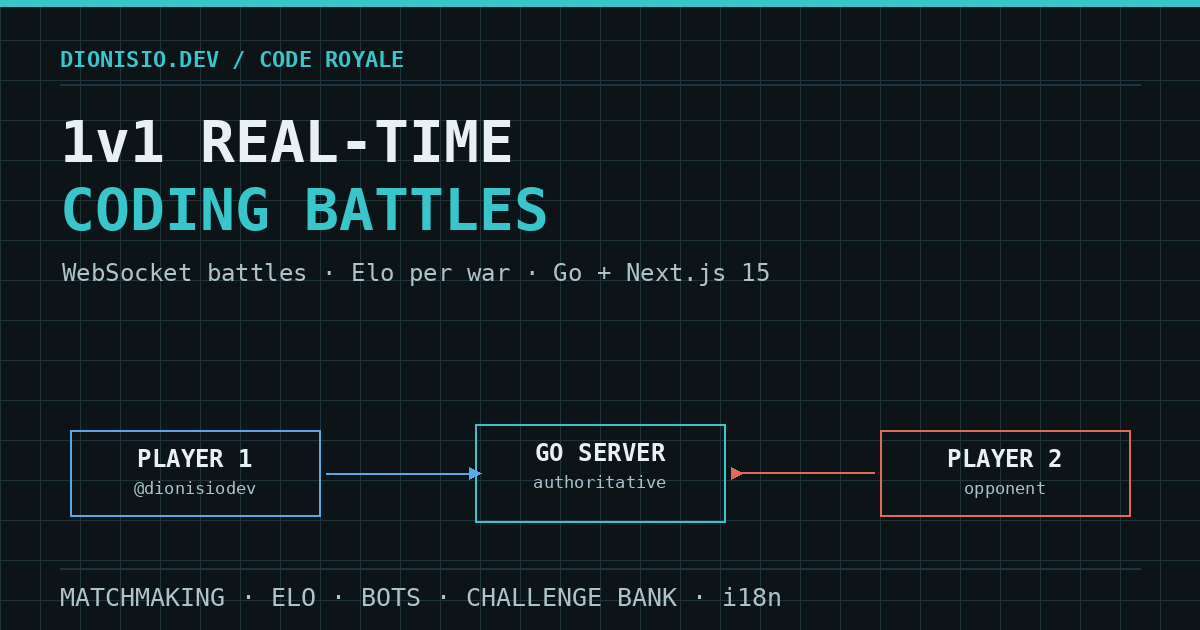
Code Royale is a 1v1 coding battle game. Both players get the same challenge at the same time, answer as fast and as accurately as they can, and whoever fills their energy bar first wins the round. Rounds stream until someone hits the target score, and Elo updates per programming topic. You can read the full case study here. This article is about the four engineering decisions that game forced on me, and what they generalize to.
Decision 1 — The server owns everything; the client owns nothing
Section titled “Decision 1 — The server owns everything; the client owns nothing”The first instinct when you write a multiplayer game is to make the client smart. The client has the challenge, it knows the answer, so let it check the answer and tell the server. Faster, right?
Wrong, and dangerously so. The moment the client decides the score, you have two problems:
- Cheating — anyone can open devtools and submit “correct” without answering.
- Divergence — two clients compute subtly different states and drift apart with no way to reconcile.
So the architecture is the opposite of a CRUD app. The server is the only source of truth. The client does not compute the score; it renders the last state the server sent and sends intents:
client -> server: { type: "submit_answer", challengeId, choice }server -> client: { type: "answer_result", correct, scores, energy }client -> server: { type: "forfeit_battle" }This is exactly the model of a game server, and it is the single decision that separates a toy from something you can ship. Once the server owns the state, everything downstream — reconnect, anti-cheat, spectating, bots — becomes a variation on the same theme instead of a special case each time.
The subtle part is not the socket. It is the gap between sending an intent and hearing back. Do you show “correct!” immediately, or wait for the server?
For multiple-choice answers, Code Royale waits. The button is pessimistic. An optimistic “correct!” that later gets rolled back is worse than half a second of waiting, because the player learns to distrust the game’s own feedback. Trust is the product; latency you can hide, a lie you cannot.
Decision 2 — A countdown is harder than it looks
Section titled “Decision 2 — A countdown is harder than it looks”A ticking clock seems like the simplest thing on the screen. It is where most real-time apps quietly break.
Three failure modes showed up in testing, all of them visible to the player:
Rounding mismatch. If the client floors and the server ceils (or vice versa), the displayed number bounces between N and N−1 several times per second. The player sees a number that can’t make up its mind. The fix is boring and mandatory: both sides use the same rounding, in the same direction.
Ping-driven jitter. A naive implementation recomputes “time left” from scratch on every server message. Each ping lands a few milliseconds off, so the seconds stutter. The fix is to stop deriving the clock from the server: the client owns one absolute deadline and derives every displayed second from it locally.
Background throttling. This is the one that surprises people. When a tab goes to the background, browsers throttle timers down to roughly once per minute. Your countdown freezes while the player is away — and the player comes back to a clock that is simply wrong.
The model that survives all three:
- the client holds one absolute deadline, computed once at round start
- the displayed second is derived from it every frame, no recomputation from server pings
- server pings only correct accumulated drift, and only when the disagreement exceeds a threshold
- on
visibilitychange, the client re-syncs the clock immediately
The result is a countdown that is correct across reconnects, background tabs, and clock skew — because it only ever tracks one number, and it lets the server nudge that number instead of replacing it.
Decision 3 — An empty queue is a dead product
Section titled “Decision 3 — An empty queue is a dead product”Matchmaking looks like an algorithm problem. It is a product problem.
The naive approach is “find me a player at my rating.” If nobody is there, the user waits. Then they leave. Then the queue is emptier, so the next user waits longer, and leaves too. That is how a real-time product dies — not with an error, but with silence.
Code Royale’s matchmaking is a per-war queue with a widening Elo window:
t = 0s : exact Elo buckett = 5s : ±1 buckett = 10s : ±2 bucketst = 20s : unlimitedt = 30s : spawn a bot at the player's EloTwo things matter here. First, the window widens over time — a slightly unfair match beats no match. Second, the bot fallback is part of the feature, not an error handler. The battle engine treats a bot exactly like a human: same code path, same messages, same timer. The only difference is what is on the other end of the socket.
That design choice pays off repeatedly. The bot keeps the game playable at 3 a.m. with zero users online, it gives new players a first match instead of an empty lobby, and it costs almost nothing because it reuses the entire human path.
The generalization: decide up front when to stop searching and start playing. Degrading gracefully is not a fallback you bolt on later; it is a designed behavior with a threshold.
Decision 4 — One identity, many ladders
Section titled “Decision 4 — One identity, many ladders”The first version had a single Elo per player. It was wrong, and the reason is worth stating.
A single rating conflates unrelated skills. A player who is strong in Go gets no credit for it when they queue for a SQL battle, and a loss in a topic they have never studied drags down their “real” rating. The number stops meaning anything, so the ladder stops motivating anyone.
The fix is a player_war_elo row per (player, war). The same account carries a different rating in
each programming topic, computed independently from battles in that topic. Which battles count is
determined by membership in a junction table, not by guessing from an ID prefix — a small schema
decision that keeps the data honest.
The product consequence is large: a new topic is a new ladder to climb, not a reset of everything you earned. Adding a domain becomes an invitation instead of a punishment.
The bank of challenges is a correctness problem
Section titled “The bank of challenges is a correctness problem”The least glamorous lesson, and the most important one for anything content-driven.
The challenge bank is data. Data can be wrong. Three real examples from this project:
- a multiple-choice question whose two best answers are both defensible
- a code-analysis prompt whose expected output depends on a leading space that the HTML collapses — so two different answers render identically and the question becomes unanswerable
- a challenge attached to the wrong topic, so it shows up where it does not belong
None of these crash the app. No exception, no error log. They just quietly make the game unfair, and unfair is the one thing a competitive product cannot survive.
So the bank is managed like a software artifact, not a spreadsheet:
- typed challenge kinds with validated shapes
- per-war membership in an explicit junction table
- an audit pass that checks correctness against the actual answer key
- bulk-fix tooling for mechanical corrections, like recomputing every expected output at once
The rule I keep coming back to: a wrong “correct answer” is worse than a crash. A crash is loud and gets fixed. A wrong answer key is silent and erodes trust one match at a time.
What generalizes beyond a game
Section titled “What generalizes beyond a game”Code Royale is a game, but these decisions are not game-specific. They show up any time a product has to agree with itself in real time:
- Where is the single source of truth for score, and for time? If two systems can compute the same value, they will eventually disagree. Pick one owner.
- What happens between an intent and its acknowledgement? That gap is a product decision, not a UI detail. Optimistic feels fast; pessimistic feels honest. Choose deliberately.
- When the queue is empty, does the product degrade or die? Silence is an outage. Design the fallback as a feature with a threshold, not as an error handler.
- Is the content actually correct, or merely present? Content-driven products fail on correctness, not on rendering.
None of these require a game engine. They require deciding, in advance, which failures are unacceptable — and then designing so they cannot happen silently.
Where to go next
Section titled “Where to go next”If you want to dig into the code and the deeper case study:
- the full Code Royale case study — architecture, trade-offs, and study exercises
- Parallelism vs. Concurrency — the mental model behind the battle engine’s timer and goroutines
- Cache Affinity — the cost model behind low-latency server state, and why where your data lives matters as much as what your code does
If there is one sentence to take away: in a real-time product, the clock is part of the contract. Design for it the moment you design your state, or it will design its own rules without you.