Smart Pointers in C++ — Choosing Between unique_ptr, shared_ptr and weak_ptr
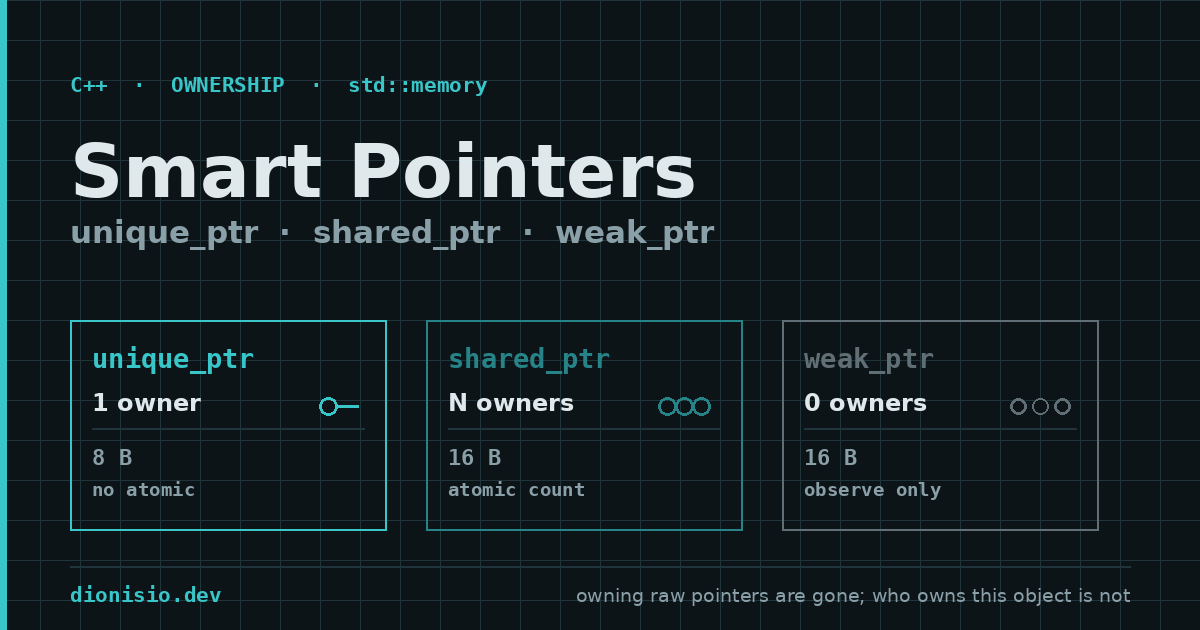
C++ · Ownership · std::memory
Most smart pointer bugs are not memory bugs. They are ownership bugs.
Nobody double-frees a shared_ptr. They pass one by value into a callback that outlives the object, and then wonder why nothing is ever destroyed.
If you have written C++ in the last decade, you know the three names. unique_ptr for exclusive ownership, shared_ptr for shared, weak_ptr to observe without owning. Repeating that is not useful.
What is useful is the part that is not in the one-line summary: shared_ptr is not “the safe pointer.” It is a specific ownership model with a specific cost, and most of the bugs people blame on smart pointers are actually the wrong model chosen for the problem. A shared_ptr passed by value into a lambda that outlives its scope does not crash — it silently keeps an object alive for the lifetime of the process. That is a different failure than a double free, and it is much harder to find.
There is also a Portuguese edition.
The Decision That Matters Is the First One
Section titled “The Decision That Matters Is the First One”Before any API question, answer this: how many owners does this object have?
| Owners | Type | Why |
|---|---|---|
| Exactly one | std::unique_ptr<T> | No overhead, no atomic, moves transfer ownership |
| The last one of several | std::shared_ptr<T> | Reference-counted lifetime |
| Zero — I only need to look | T* or T& | A non-owning reference |
| Zero — I need to check if it still exists | std::weak_ptr<T> | Observes a shared_ptr without keeping it alive |
| No dynamic allocation needed | T | A value. This is the most underused option. |
Most codebases would improve by moving entries up this table, not down. If you cannot name the second owner, there is no second owner, and shared_ptr is buying you an atomic increment you did not need.
The signal that you picked wrong is usually a shared_ptr in a function parameter. Ask what the function does with ownership: if it does not store the pointer, does not hand it to something that outlives the call, and does not need to observe the count, it does not need a shared_ptr. It needs a reference.
// The signature says "I might take ownership." It doesn't — it reads the value.double price_of(const std::shared_ptr<Instrument>& inst);
// The signature says "I need this to exist right now." That is the truth.double price_of(const Instrument& inst);
// The signature says "I might store this, or nothing." Also the truth.void register_instrument(std::shared_ptr<Instrument> inst);
That distinction is the entire cost of the article. A shared_ptr parameter that is never stored is a lifetime extension the caller did not intend, and it is invisible at the call site: price_of(ptr) and price_of(*ptr) look equally reasonable.
unique_ptr: The Default, Not the Fallback
Section titled “unique_ptr: The Default, Not the Fallback”unique_ptr should be your first reach. It is a zero-overhead abstraction, it moves, it refuses to copy, and when it dies the object dies. There is nothing to tune.
#include <memory>#include <cassert>
struct Connection { ~Connection() { /* release */ } };
std::unique_ptr<Connection> make_connection() {    return std::make_unique<Connection>();   // C++14}
int main() {    auto conn = make_connection();    assert(conn != nullptr);    auto moved = std::move(conn);    assert(conn == nullptr);                 // moved-from is valid and empty}
Three details that come up in review:
make_uniqueis C++14;unique_ptritself is C++11. If you are on C++11 you are writingstd::unique_ptr<T>(new T(...))— which is correct, just verbose. The version map tracks this.make_uniqueis not just convenience. It calls the constructor and the allocation in one expression, so there is no window where a thrown constructor leaks.f(std::unique_ptr<T>(new T), g())can leak in C++11 because argument evaluation order is unspecified;make_uniquecloses that hole.- The deleter is part of the type.
unique_ptr<T, D>with a customDis not the same type asunique_ptr<T>, and it changes the size. A function returning the wrong combination fails to compile — which is the point.
For arrays, unique_ptr<T[]> exists and calls delete[]. Prefer a container. The exception is a fixed-size, non-owning-elsewhere buffer you cannot express otherwise, and that is rare.
shared_ptr: What You Are Actually Paying For
Section titled “shared_ptr: What You Are Actually Paying For”A shared_ptr<T> is two pointers: one to the object, one to a control block. That control block holds the strong count, the weak count, and the deleter.
shared_ptr<T> ──┬──> T (the object) └──> control_block { strong: 2, weak: 1, deleter }Three consequences follow, and all three cause real bugs:
- Every copy is an atomic operation. Copying a
shared_ptris a relaxed atomic increment; destroying it is an acquire/release decrement. That is cheap but not free, and in a hot loop it is not a rounding error. Pass byconst&when you only read. - Two allocations, unless you use
make_shared.std::shared_ptr<T>(new T)allocates the object, then allocates the control block.std::make_shared<T>()allocates both in one block. That is faster and more cache-friendly — and it has a consequence people do not expect: the object’s memory is not freed until the lastweak_ptralso dies, because the control block and the object share an allocation. With a long-livedweak_ptr,make_sharedkeeps the memory alive after the destructor has run. - The count is shared, the pointer is not. Two
shared_ptrs to the same object are fine. Two independently createdshared_ptrs to the same raw pointer are a double free, because each has its own control block. This is the classic mistake withthis:
struct Widget { // WRONG: creates a second control block on every call -> double free std::shared_ptr<Widget> self() { return std::shared_ptr<Widget>(this); }};The fix is enable_shared_from_this, and only when the object is genuinely managed by a shared_ptr:
#include <memory>
struct Widget : std::enable_shared_from_this<Widget> {    std::shared_ptr<Widget> self() { return shared_from_this(); }};
// Call it only after a shared_ptr owns the object:// auto w = std::make_shared<Widget>();// auto s = w->self();          // OK: shares the existing control block
Calling shared_from_this() on an object that no shared_ptr owns throws std::bad_weak_ptr, or is undefined before C++17. That is the trap: the constructor cannot call it, because the shared_ptr does not exist yet. Move that work to a factory function or an explicit init().
weak_ptr: Breaking Cycles, Observing Without Owning
Section titled “weak_ptr: Breaking Cycles, Observing Without Owning”weak_ptr exists for two jobs, and mixing them up causes leaks.
Job one: hand out a reference that does not extend lifetime. A cache holding shared_ptrs would keep every entry alive forever. Holding weak_ptrs keeps the count honest — the entry dies when the real owners are done.
#include <iostream>#include <memory>#include <vector>
class Registry {    std::vector<std::weak_ptr<int>> entries_;public:    void add(const std::shared_ptr<int>& item) { entries_.push_back(item); }
    void report() const {        for (const auto& weak : entries_) {            if (auto locked = weak.lock()) {          // temporary strong ref                std::cout << "alive: " << *locked << '\n';            } else {                std::cout << "expired\n";             // owner is gone            }        }    }};
lock() returns a shared_ptr that is either valid or null — never a dangling pointer. Note the shape of the loop: the shared_ptr lives only inside the if, so it cannot accidentally extend the lifetime past the statement. If you find yourself storing the result of lock(), ask whether you actually wanted to own it.
Job two: break a strong reference cycle. Two shared_ptrs pointing at each other keep both alive forever, and neither destructor runs.
struct Node { std::shared_ptr<Node> next; // strong: "I own my successor" std::weak_ptr<Node> parent; // weak: "I know who owns me"};A doubly-linked list of shared_ptrs is the canonical leak. The rule: in a parent/child relationship, the parent owns strongly and the child points back weakly. Draw the graph before you pick the type.
Common APIs: Where Lifetimes Quietly Change
Section titled “Common APIs: Where Lifetimes Quietly Change”Several standard APIs are shared_ptr-shaped, and each has a lifetime rule that surprises people:
std::enable_shared_from_this— covered above. Requires prior ownership.std::static_pointer_cast/dynamic_pointer_cast/const_pointer_cast— these share the control block, so the count is preserved.dynamic_pointer_caston a failed cast returns an emptyshared_ptr. Use these instead of casting the raw pointer and rebuilding ashared_ptr, which would create a second control block.std::atomic<std::shared_ptr<T>>— C++20. In C++11/14/17, thestd::atomic_*free functions on ashared_ptrare the supported form, and they are not lock-free in general. If ashared_ptris being read and written from multiple threads, a plainshared_ptris a data race even though the count itself is atomic. The count is thread-safe; the pointer is not.std::weak_ptr::lock()— the only correct way to get a strong reference from a weak one. Neverweak.lock().get()and store the raw pointer.
What It Costs
Section titled “What It Costs”Rough numbers on a 64-bit machine, all in bytes and cycles, because “smart pointers are free” is a claim worth checking:
| Type | Size | Copy cost |
|---|---|---|
unique_ptr<T> (default deleter) | 8 bytes | not allowed |
unique_ptr<T, D> with stateful deleter | 8 + sizeof(D) | not allowed |
shared_ptr<T> | 16 bytes | 1 atomic increment + pointer copy |
weak_ptr<T> | 16 bytes | 1 atomic increment (weak count) |
control_block | ~24 bytes + deleter state | — |
Two takeaways. First, unique_ptr is the size of a raw pointer and compiles to the same code — there is no argument for raw owning pointers once you can use it. Second, shared_ptr is not “a pointer with safety”; it is a pointer plus an atomic plus a heap allocation, and in a structure-of-arrays style data path that is the difference between fitting in cache and not.
For the performance side of that trade-off, see Cache Affinity.
C++17 and Later: The Small Wins
Section titled “C++17 and Later: The Small Wins”If your baseline is C++17 or newer, a few extras remove real friction:
std::unique_ptrinifinit statements —if (auto handle = acquire(); handle) { ... }scopes the ownership to the branch, which is exactly the lifetime you meant.- Structured bindings make the pair-of-pointers nature of
shared_ptrvisible when you need it, though you almost never should. std::make_uniqueandstd::make_sharedare the default. Writingnewoutside a factory function is a code smell worth flagging in review.std::inplace_vectorand friends (C++26) reduce the cases where you needed heap allocation at all. The best way to avoid smart pointer costs is to avoid the allocation.
The C++ by version map is worth keeping open while you decide what your project can actually compile.
The Review Checklist
Section titled “The Review Checklist”Five questions that catch nearly every smart pointer defect I have seen in production:
- Is there more than one owner? If not,
unique_ptr— or a value. - Does this
shared_ptrparameter get stored? If not, it should beT&orT*. - Is there a cycle? Draw the ownership graph. Any loop needs a
weak_ptrsomewhere, and it should be the back-edge. - Was
shared_ptr(this)ever written? It should beenable_shared_from_this. - Is this pointer read and written across threads? The count is atomic; the pointer is not. Use
atomic<shared_ptr<T>>(C++20) or the atomic free functions, or restructure so it is not shared.
Note what is missing: none of these questions are about delete. RAII already solved that. What remains are questions about who owns what, and the compiler cannot answer those for you — a type can only encode the model you chose.
Keep Reading
Section titled “Keep Reading”- RAII in C++ — the mechanism these types are built on, and where ownership in a type system comes from.
- Parallelism vs. Concurrency — the context where the atomic-increment cost and the thread-safety caveat actually bite.
- Practical C++ learning path — ownership, move semantics, ranges and performance, with exercises and a free checklist.
- C++ by Version — when
make_shared,make_uniqueandatomic<shared_ptr>arrived.
Smart pointers do not remove the question of ownership. They make it possible to answer it once, in the type, instead of at every call site — which is only an improvement if the answer you wrote down was the true one.