Amorfy
Amorfy
Section titled “Amorfy”What this project is
Section titled “What this project is”Amorfy is a very good case for studying guided product flow.
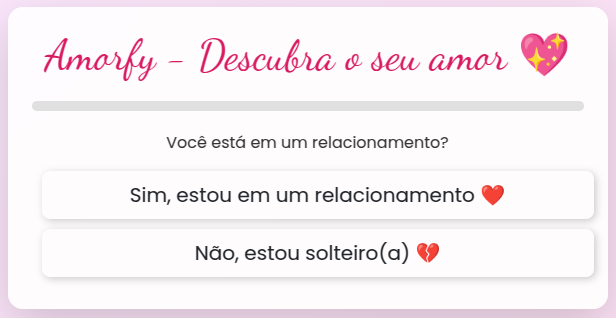
Instead of dumping everything on screen at once, it takes the user through steps until a result is reached.
This kind of experience looks simple on the surface, but it requires a lot of good decisions behind it:
- order of steps
- pace of progression
- clarity of language
- reduction of abandonment
- perception of value in the final result
What problem it solves
Section titled “What problem it solves”Questionnaire-based products usually have a classic challenge:
how do you get the user through a relatively long flow without exhausting them, confusing them, or losing them halfway through?
That is exactly the kind of problem Amorfy is useful for studying.
It is not only about “showing questions.”
It is about building a journey.
Why this case is valuable for developers
Section titled “Why this case is valuable for developers”Many people learn frontend by thinking only in components.
But guided products teach something bigger:
- state
- progression
- context
- copy
- feedback
When the product depends on multiple steps, the interface stops being only visual.
It becomes a guidance system.
What to study here as a developer
Section titled “What to study here as a developer”1. Multi-step flow
Section titled “1. Multi-step flow”A guided questionnaire usually requires:
- current step
- history
- ability to move forward
- sometimes the ability to go back
- answer persistence
That makes the project a great case for state modeling.
2. Long-form UX
Section titled “2. Long-form UX”A short form is just a conversation.
A long form becomes a risk.
So projects like this teach:
- how to reduce friction
- how to break cognitive load
- how to keep the user oriented
- how to create a sense of progress
3. Copy as part of product engineering
Section titled “3. Copy as part of product engineering”Here the interface writing is not a side detail.
It influences:
- understanding
- trust
- continuation
- engagement
This kind of project is great for understanding that strong products are not built from code alone.
4. Mapping answers to a result
Section titled “4. Mapping answers to a result”A case like this is also excellent for thinking about:
- scoring rules
- result categories
- classification criteria
- consistency of the final feedback
Even when business logic feels “soft,” it still needs clear modeling.
Mental model of the flow
Section titled “Mental model of the flow”A useful way to read this project is:
Answer input | vStep validation | vProgress persistence | vInterpretation / classification | vFinal resultThis shows that behind a friendly interface there is real product logic.
What is worth observing in the experience
Section titled “What is worth observing in the experience”While browsing, pay attention to:
- how the user understands the next step
- how clear the current stage feels
- how the product avoids overloading the screen
- how the result is communicated
- how the copy reduces uncertainty
These details matter a lot for retention.
Interface states this kind of project usually needs
Section titled “Interface states this kind of project usually needs”This kind of flow typically involves states like:
- current step
- total progress
- answers already given
- field validation
- final submission
- result loaded
- error or invalid-answer state
That is gold for anyone learning to model interfaces without turning them into chaos.
Structures and patterns that make sense with this case
Section titled “Structures and patterns that make sense with this case”It is worth thinking about:
- array/list for question sequence
- object/map for answer storage by key
- state-machine thinking for progression
- incremental validation
And from an algorithmic perspective:
- score mapping
- answer aggregation
- rule-based classification
- step navigation
Product trade-offs that show up here
Section titled “Product trade-offs that show up here”Clarity versus depth
Section titled “Clarity versus depth”The more questions you ask, the more context you collect.
But it also increases:
- fatigue
- abandonment
- friction
So the product needs to balance depth and continuity.
Rich result versus transparent rule
Section titled “Rich result versus transparent rule”If the final result becomes too complex, internal logic becomes harder to maintain.
If it is too simple, the user may feel less value.
That balance is one of the most interesting parts of the case.
Emotional interface versus objective interface
Section titled “Emotional interface versus objective interface”Projects like this often depend heavily on tone, narrative, and perception.
That changes how you design the experience.
How to turn this case into active study
Section titled “How to turn this case into active study”Strong exercises you can extract from it:
- design a data structure for questions and answers
- model the questionnaire state
- create a scoring and classification rule
- map where the user may abandon the flow
- propose a UX improvement to reduce friction
This is strong practice because it mixes:
- logic
- modeling
- UX
- product
Strong questions to ask yourself
Section titled “Strong questions to ask yourself”- Where can the user get stuck?
- Is the progress clear enough?
- Does the result logic feel consistent?
- Is the answer system easy to maintain?
- Does the final value justify the effort of the flow?
If you learn to ask those questions, you are already studying product like an engineer.
Useful comparison with other portfolio projects
Section titled “Useful comparison with other portfolio projects”Compare this case with:
- Wheel Of List, to see the difference between fast utility and guided journey
- SportPulse.today, to contrast an interaction-oriented product with a data-oriented one
Next actions
Section titled “Next actions”- Revisit Programming Logic while thinking about state, validation, and step transitions.
- Review Data Structures with question and answer modeling in mind.
- Use this case as reference whenever you design onboarding, guided flow, or long forms.
- Live project: www.amorfy.com.br
- Back to Projects